
Market stalls and prison cells once shared the same building at Bonsecours. Food sales occupied its lower levels alongside a police station, before parliamentarians and Montreal’s municipal council brought political business upstairs.
A market beside the river
In 1843, Montreal decided to replace Sainte-Anne Market, whose building was being taken over for the Parliament of the Province of Canada. The city bought properties along the waterfront and held an architectural competition. William Footner’s design won. Excavation began in September 1844, the market opened in January 1847, and its dome was built that year.
The market worked across two street levels. Stalls occupied the floor opening onto Rue de la Commune and the ground floor along Rue Saint-Paul. Selling food was built into its relationship with the waterfront streets. Nearby Place Jacques-Cartier kept some of its produce sellers after Bonsecours opened. The new hall therefore joined an existing landscape of outdoor trading, rather than gathering every seller into a single enclosed space.
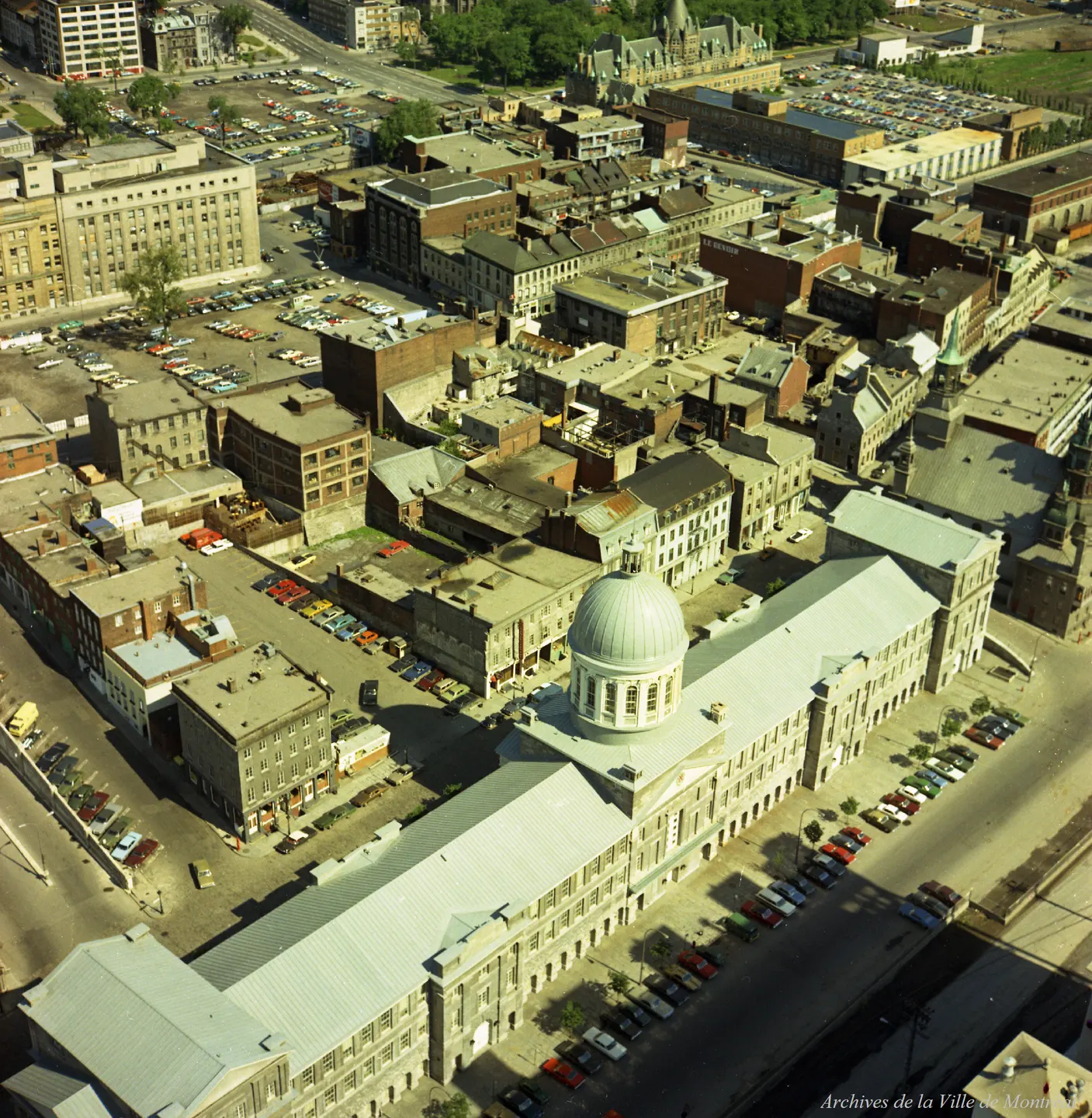
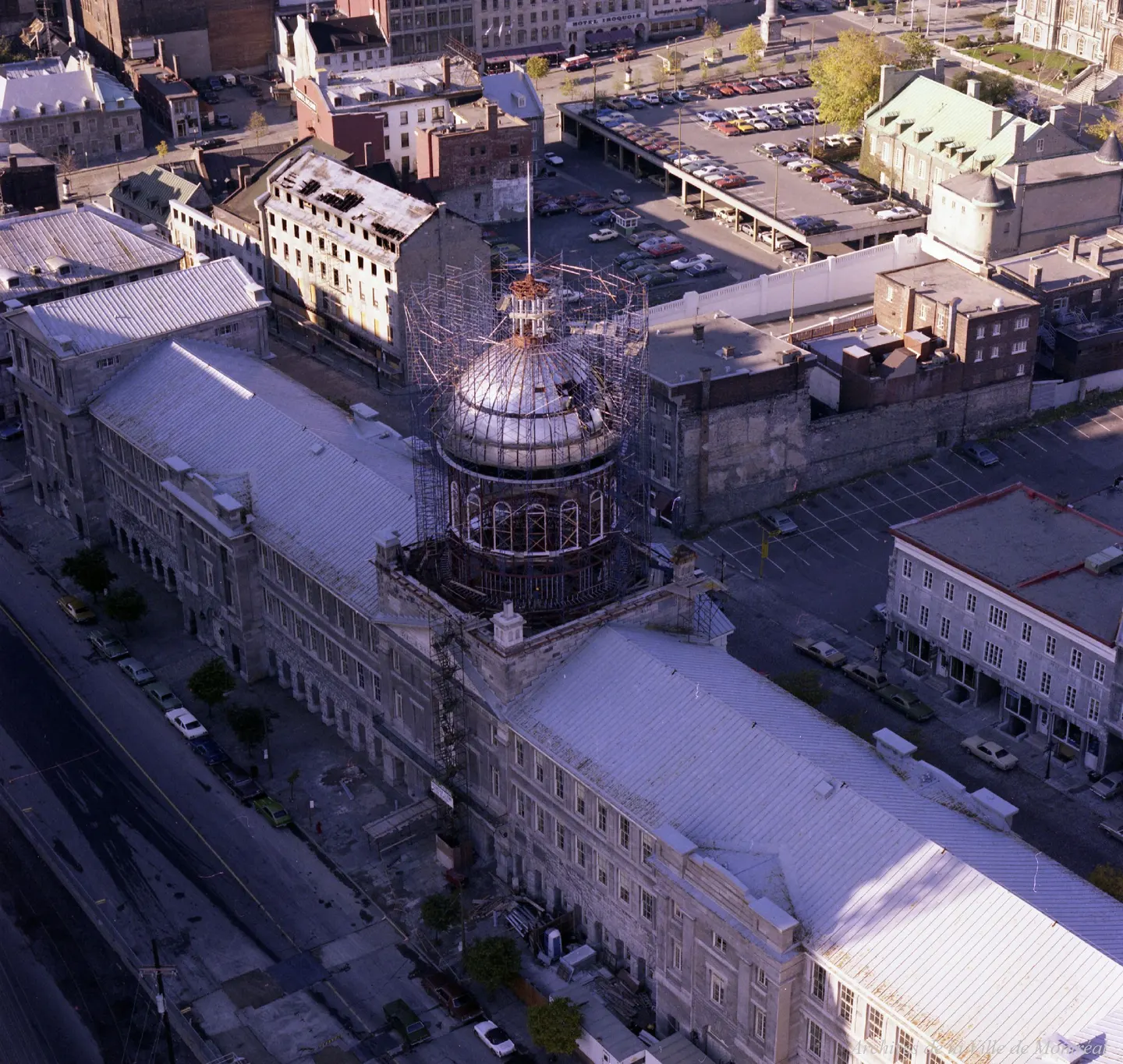
VM94-B095-003 · VM94-B224-005
Room for public business
The building was planned for more than commerce. George Browne directed another phase of work on the upper floor in 1848, preparing municipal offices in the west and concert rooms in the east. While food was bought and sold below, assemblies and performances could take place above. Those civic and cultural functions belonged to the market’s early design, rather than arriving only after its trading days were over.
When fire destroyed the parliament in Sainte-Anne Market in 1849, legislators briefly moved into Bonsecours before finding another location. Montreal’s council stayed much longer. It took up residence in 1852 and remained until 1878, when it moved to the new city hall on Rue Notre-Dame. Concerts, banquets and meetings also filled the halls. During those years, an appointment at the market might concern groceries, a public celebration or a decision about the running of the city.
When wholesale trade moved on
After a major fire in 1891, market activity came to dominate the building. Wholesale business grew particularly important in the twentieth century. Bonsecours continued to link the city with agricultural producers, but the movement of goods changed around it. A reorganized road network and the arrival of heavy trucks eventually made the old market less useful for wholesale trading.
The food market closed in the early 1960s. Its interior was opened up and refitted as municipal offices, keeping the building in use while changing the spaces previously occupied by merchants. By the time of the aerial views from the 1970s, the agricultural market had already gone. Its familiar name survived the change of function, holding onto an older association between the waterfront building and food arriving in Montreal.
A building open to different uses
Another round of work began in the 1990s. Reception and exhibition spaces were introduced in 1992. Further alterations, completed in 1997, created a shopping gallery with boutiques and restaurants on the levels of Rue Saint-Paul and Rue de la Commune. Offices, conference rooms and exhibition halls occupied the floors above. The renewed mix of activities echoed a building that had accommodated public business alongside trade from the start.
Today the entrance at 350 Rue Saint-Paul Est leads into shops and public spaces in Old Montreal. Walking around to Rue de la Commune reveals the other side of its arrangement across the street levels. The dome ties the two views together. Below it, the market’s rooms have served successive forms of city life, from selling produce and governing Montreal to exhibitions and the businesses visitors find inside now.