
After work in Mount Royal Park, Prosper Bélec stopped at Saint-Jean-Baptiste Market to buy a live hen. At home on Rue Rivard, his wife Ida prepared it for supper, connecting the mountain, the market and the family table in one routine.
A village’s public rooms
In the early twentieth century, the market occupied the northeast corner of Rachel and Boulevard Saint-Laurent. The Bélec family lived nearby, in what had been the separate municipality of Saint-Jean-Baptiste. Post and telegraph offices, hotels and shops surrounded the trading place. Farmers brought produce in and later headed home, their carts sharing the boulevard with trams. Getting food into the neighbourhood was part of the street’s daily movement.
A market stood here around 1870, while Saint-Jean-Baptiste was still a village outside Montreal. Its building also housed municipal business. Council met in an upstairs room used for performances and political meetings, bringing public administration together with the buying and selling below. The municipality joined Montreal in 1886, seeking better municipal services. Its market remained part of neighbourhood life after the separate council had gone.
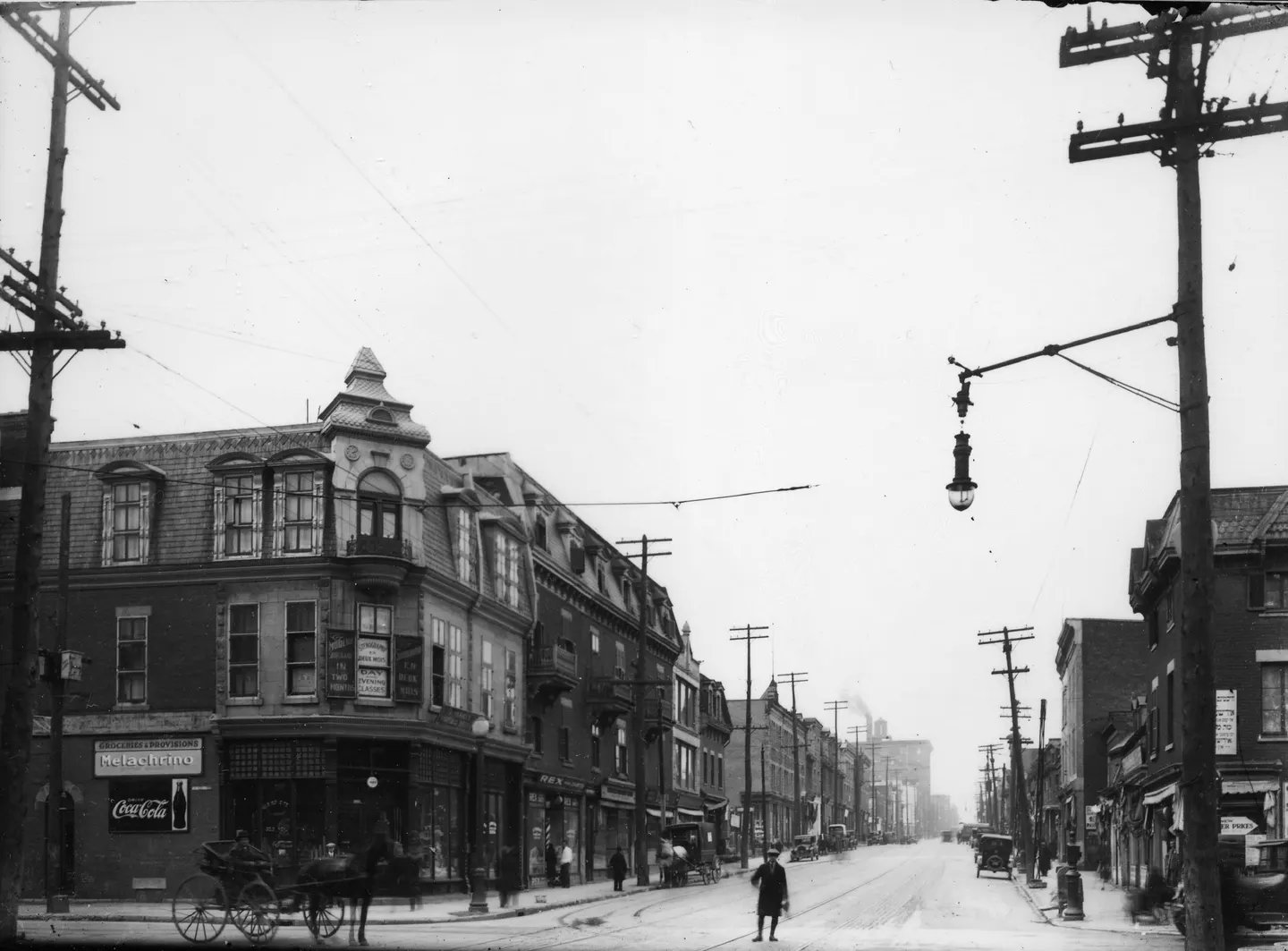
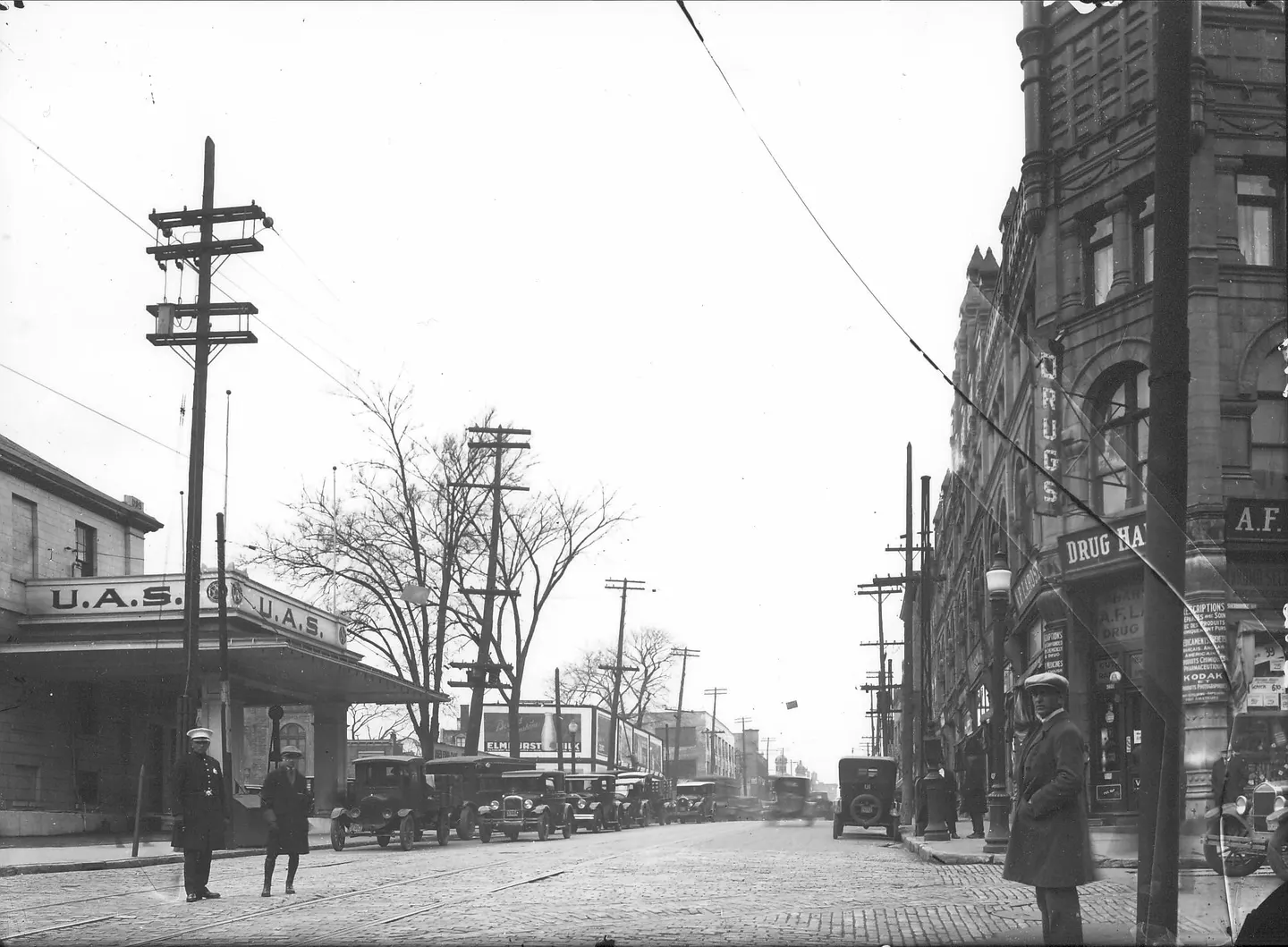
VM94,SY,SS1,SSS17,D12 · VM94,SY,SS1,SSS17,D11
New halls during the Depression
The old building was eventually replaced. Municipal authorities decided to remake the market in 1931, employing unemployed workers through public works during the economic crisis. The new halls took on an Art Deco appearance. Their form changed, but the purpose of gathering local food traders and their customers at a shared address continued within the replacement building.
Butchers and fishmongers traded indoors, while produce growers used sheltered stalls outside. Market and boulevard worked together rather than as separate spaces. The Main remained the route connecting these businesses even as particular buildings along it were renewed or replaced.
A shop outlasts the market
Simcha Leibovich and Fanny Schwartz opened a grocery in the halls in 1948, two years after arriving from Romania. Among their customers was the Jewish community, for whom they stocked particular products. Their shop added a family business to the market’s longer history. Like the Bélecs’ shopping routine, it connected a public trading place with the food people needed and prepared at home.
Growing competition from supermarkets weakened the halls, whose condition also became a concern. They were demolished in 1966. Leibovich and Schwartz moved their grocery to Saint-Laurent and Napoléon, where it stayed until 2005. The market’s disappearance therefore did not immediately end every business that had begun inside it. Some of that commercial life continued at another address along the same boulevard, beyond the walls of the former halls.
What replaced the stalls
A car park first took the place of the demolished market. Parc des Amériques was laid out in 1990 and 1991 in honour of the Latin American community. Its name recalls people driven into exile by South American dictatorships. The land changed purpose again: after selling food and accommodating cars, it became an outdoor place to pause and spend time.
The site is still easy to locate at Rachel and Saint-Laurent in Le Plateau-Mont-Royal. The park occupies the corner vacated by the halls. Looking across the intersection towards the boulevard gives the vanished market a setting: this was where farmers’ journeys, neighbourhood shops and family errands met. The open space visitors find today belongs to another chapter of the same small piece of the Main.